The biggest AI stories, updated as they happen — models, infrastructure, business and robotics. Open any story to read it in full.
24stories shown
Last updated: November 13, 2026
GB
ModelsNovember 13, 2026
Google launches Gemini 4 Hydrogen — a fast execution model for coding agents at $1.50 per million tokens
Google introduced Gemini 4 Hydrogen on November 12 — the fast, execution-first member of the Gemini 4 family, priced flat at $1.50 per million input tokens across a 1-million-token window and rolling out to AI Studio, the Gemini API, the Gemini app and Google Search.
ModelsNovember 13, 2026
Google launches Gemini 4 Hydrogen — a fast execution model for coding agents at $1.50 per million tokens
Google introduced Gemini 4 Hydrogen on November 12, 2026, the third member of its Gemini 4 family and the one built for speed rather than deep deliberation. Where Carbon and Argon are the frontier models for long-horizon reasoning on hard problems, Hydrogen is aimed at the everyday work of coding agents: writing code, running tests, verifying changes, doing research and carrying multi-step tasks through to completion. It is rolling out globally the same day across Google AI Studio, the Gemini API, Gemini for business, the Gemini app, Google Search, and Antigravity for paid Google AI Pro and Ultra subscribers.
The headline numbers are Google's own, and they are deliberately framed as a value play. At its default high thinking level Hydrogen scores 51 on the Artificial Analysis Intelligence Index, edging out Argon at 50, and reaches 54 at its highest xhigh setting, while Google says it finishes tasks 2.5 times faster than Gemini 3.8 Flash. Pricing is flat across the entire 1-million-token context window at $1.50 per million input tokens and $7.50 per million output tokens. The model offers four configurable thinking levels — low, medium, high as the default, and a new xhigh tier — so developers can trade quality against latency and cost per task.
Hydrogen is also the execution half of a two-model workflow Google is now selling. In Antigravity, an Orchestrator hands work between Carbon, which plans and reasons, and Hydrogen, which carries the plan out — a division of labour that mirrors how Anthropic and Meta have split their own frontier lineups into planners and cheaper workers. In the Gemini app, Hydrogen appears in the model picker for paying users, while free users get it automatically when Gemini decides it suits the prompt, and in Search it runs behind the scenes for all users.
The honest caveats are worth stating plainly. Every benchmark Google cites is vendor-reported and has not been independently audited, and the Cloud model documentation adds that Hydrogen is a short-term generally available release subject to a minimum 45-day retirement notice — so developers building on it should treat it as a fast-moving target rather than a permanent fixture. Still, the direction is clear: the frontier labs are now competing as much on cheap, fast execution for agents as on raw reasoning, and Hydrogen is Google's bid to own the worker tier.
Anthropic lets enterprises run Claude Managed Agents on their own servers — in private beta
Anthropic opened a private beta on November 12 for self-hosted Claude Managed Agents — companies can now run the whole agent service, harness, sandboxes, credentials and session history, inside their own cloud or data centre.
ProductNovember 13, 2026
Anthropic lets enterprises run Claude Managed Agents on their own servers — in private beta
Anthropic announced on November 12, 2026 that self-hosted Claude Managed Agents is available in private beta, letting organisations run the entire agent service on infrastructure they control. Claude Managed Agents is the service Anthropic uses to host autonomous Claude agents that work through long jobs on their own — fixing broken builds, testing releases, triaging alerts and chewing through bug backlogs. It launched as a fully hosted service in April 2026, and Anthropic later added self-hosted sandboxes, which moved an agent's tool execution onto customer systems while Anthropic kept running the agent itself. The November 12 announcement brings the rest in-house too.
The customer now operates three pieces. The first is cma-server, which exposes the same Managed Agents API as the hosted service, runs the agent loop, and stores agents, sessions and their histories. The second is a PostgreSQL database, version 16 or later, that holds that history — without it, the server keeps data only in memory and a restart erases it. The third is the workers that run shell and file tools inside the customer's sandboxes, so the server itself never executes an agent's shell or file commands. The Claude SDK and the ant command-line tool connect to the self-hosted server just as they do to the hosted one.
The one thing that does not move home is the model itself. Each model call goes to a provider the customer picks — Anthropic by default, or Amazon Bedrock, Claude models on Google Cloud, Microsoft Foundry, or the customer's own model gateway — so self-hosting the service does not by itself keep model traffic inside the customer's network. What it does keep inside is the sensitive material around the model: agent credentials can stay in the customer's own secrets manager, and Anthropic says it has no remote access to the self-hosted server or its logs.
Access is deliberately narrow for now. The private beta is available only to eligible organisations, and the only channel is the Anthropic account team, which hands over the release archive; customers install each release themselves. Anthropic has published no pricing, no list of covered countries and no schedule for leaving beta, and the self-hosted server is not yet a feature-for-feature copy of the hosted one — scheduled deployments, dreams and webhooks are missing, and web search and web fetch stay off until explicitly enabled. For regulated enterprises, though, the trade is attractive: the agent control plane finally lives inside their own security perimeter.
OpenAI buys AI travel agent Odessia — and travel stocks slide on the news
OpenAI acquired Odessia on November 10, an AI travel concierge that planned and booked whole trips itself — its founder Francis Davidson joins OpenAI to lead travel, the standalone service shut down, and Expedia fell nearly 4% on the news.
BusinessNovember 13, 2026
OpenAI buys AI travel agent Odessia — and travel stocks slide on the news
OpenAI acquired Odessia, an AI travel agent, in a deal announced on November 10, 2026 by the startup's founder, Francis Davidson, who said he is joining OpenAI to lead its travel technology development. Odessia's website confirms the acquisition and states that the service is no longer available, directing customers with existing bookings or saved travel plans to its support email. Financial terms were not disclosed, and OpenAI has not announced a travel product or a timetable for bringing Odessia's technology into another product.
Odessia was a full-service agent rather than a conventional aggregator. Built on OpenAI's GPT 5.5 and Codex models, it planned and booked complete trips itself instead of handing users off to third-party supplier websites — and as a licensed IATA travel agency it could execute bookings directly, with access to private hotel rates that ordinary chatbots cannot reach. Davidson, who co-founded the hospitality company Sonder, launched Odessia this year with a team of eight in San Francisco and about $6 million in seed funding led by Sequoia Capital. The service opened to the public on October 14 as a free concierge reached by text, after tens of thousands of early adopters used it during summer 2026, planning travel at a rate of more than $60 million a year.
Investors read the deal as a threat to the incumbents. Shares of major online travel agencies tumbled on the announcement, with Expedia Group down nearly 4 percent, Tripadvisor down more than 3 percent and Booking Holdings down more than 2 percent, according to Seeking Alpha reporting cited by PYMNTS. The fear is straightforward: if ChatGPT can one day plan and book a trip end to end, the middlemen who currently sit between travellers and hotels lose their position — the same logic that has airlines pushing back, with United Airlines moving a day later to ban unauthorised third-party AI agents from booking its flights.
The deal fits a wider pattern at OpenAI, which launched Businesses in ChatGPT the same day, letting companies claim verified profiles inside the chatbot. What OpenAI actually bought is not just a chatbot but the unglamorous infrastructure underneath a real travel agent: accreditation, supplier relationships and a working booking flow. Whether any of that reaches ChatGPT users, and on what terms, is still unannounced — and an OpenAI spokesperson told TechCrunch only that trip planning is among the everyday tasks people bring to ChatGPT.
Anthropic says its own AI moved Claude onto AMD chips in three days — a job that used to take months
In its IPO roadshow, Anthropic says its frontier model Mythos got Claude running on AMD MI355X GPUs in about three days with almost no human help, porting or writing nearly 100% of the kernels — against 6 to 12 months by traditional methods.
ResearchNovember 13, 2026
Anthropic says its own AI moved Claude onto AMD chips in three days — a job that used to take months
Anthropic says its own AI did in about three days a job that used to take its engineers months: getting Claude to run on a new kind of chip. The claim comes from the company's IPO roadshow video, in the chapter on its approach to compute, where co-founder and Chief Compute Officer Tom Brown says the frontier model Mythos got Claude running on AMD graphics processors "with basically no human intervention". He adds that Claude "ported or wrote almost 100 percent of the kernels" — the small, heavily tuned programs that do a model's maths on a particular chip, and that every chip family needs its own set.
A chart shown in the roadshow sets the three days against roughly 6 to 12 months for the traditional approach, which Brown described as dozens of engineers working for months. The fine print matters, though: a footnote under the chart limits the claim to the approximate time for Claude Mythos Preview to bring up prompt processing — the stage where a model reads its input before it starts writing an answer — for one Anthropic model on AMD Instinct MI355X GPUs at a useful level of performance. It does not say a whole model, or training, moved to AMD in that time, and the 6 to 12 month figure is based on Anthropic's own historical experience bringing up new accelerators.
The claim lands because of what it threatens. Most AI software is written for CUDA, Nvidia's programming platform, and moving to rival hardware means rewriting and re-tuning the kernels underneath — a cost that has kept Nvidia's ecosystem sticky even as rivals' chips caught up on raw speed. Anthropic now says it trains and serves Claude across four major chip families — AWS Trainium, Google TPUs, Nvidia GPUs and AMD GPUs — treating them as one interchangeable pool. The AMD relationship runs deeper than this one port: in July 2026 the two firms announced a partnership under which Anthropic will deploy up to 2 gigawatts of AMD's next MI450 chips from the first half of 2027, AMD will invest up to $5 billion, and Claude itself will help optimise ROCm, AMD's rival to CUDA.
Both numbers are Anthropic's own, from marketing for its share sale — final pricing is expected on November 18, with trading on Nasdaq under the ticker ANT the next day — and they have not been independently verified, a point The Decoder stresses in its own reporting. AMD has not commented. And even if the three-day figure holds up exactly as stated, one prompt-processing bring-up does not by itself dissolve CUDA's moat, which is an ecosystem of libraries, tools and years of optimisation, not just kernels. But as a demonstration of what frontier models can now do to infrastructure work, it is striking: one AI model moved another AI model onto a competitor's hardware over a long weekend.
Grok Bot hits 1.0 on Mac — and can now read your Messages, Mail and Notes
xAI's Grok Bot left beta on November 12 with version 1.0 for Mac, adding native access to seven Apple apps — Messages, Mail, Notes, Reminders, Calendar, Location and Contacts — through a per-app Connect Apps screen.
ProductNovember 13, 2026
Grok Bot hits 1.0 on Mac — and can now read your Messages, Mail and Notes
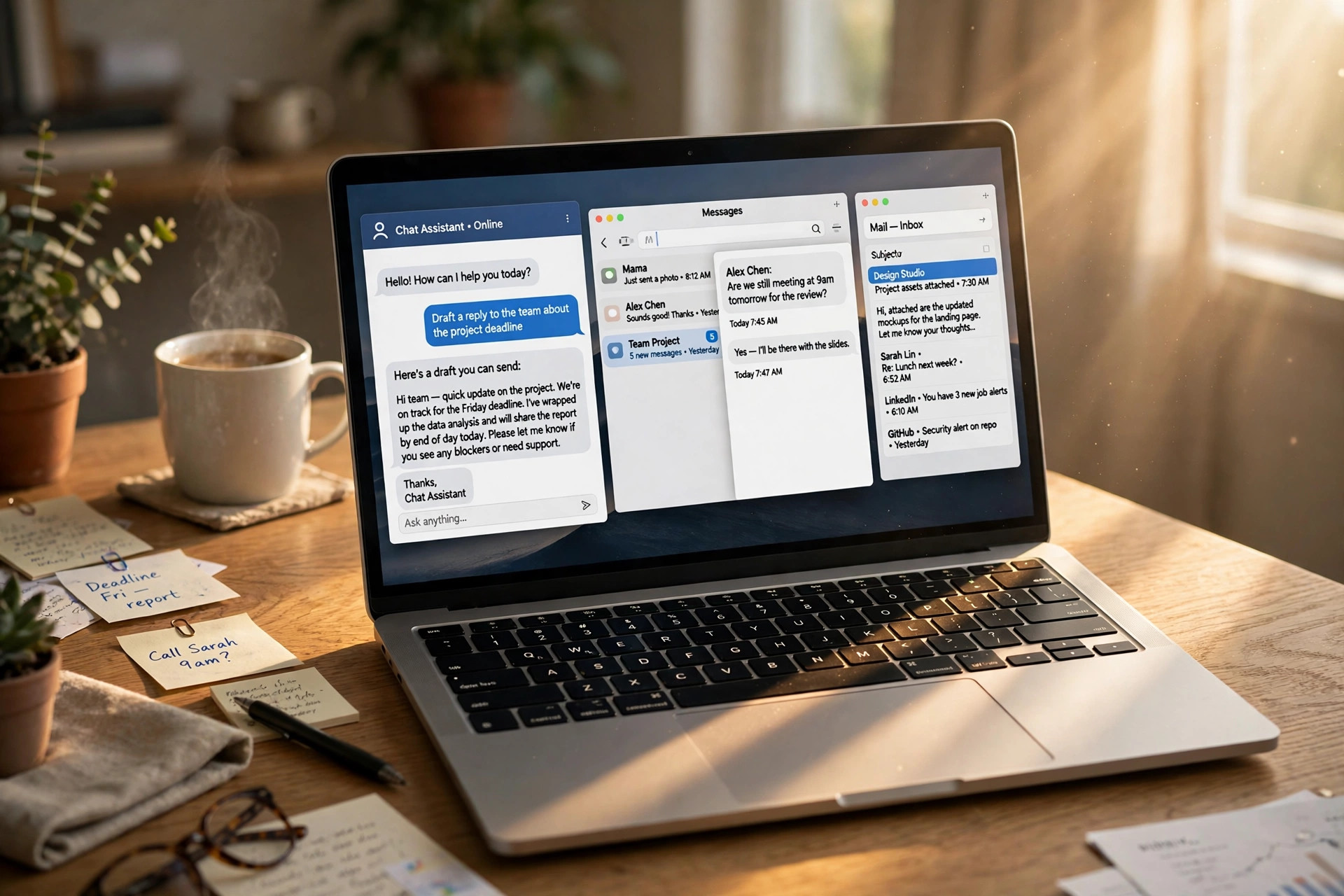
Grok Bot, the always-on AI agent app from xAI, reached version 1.0 on Mac on November 12, 2026, leaving beta behind — and the headline feature is a deep one. Announced by the official Grok Bot account on X, the Mac app can now work inside seven of Apple's own apps: Messages, Mail, Notes, Reminders, Calendar, Location and Contacts. The move turns Grok Bot from a standalone chatbot into something much closer to a Mac assistant, able to act on the context already sitting in the apps its users live in all day.
The capabilities are specific to each app. Messages is the most powerful of the lot: Grok Bot can read conversations and send replies on the user's behalf. Mail gets the same treatment — it can search the inbox for a message or a thread and draft emails to send. Notes can be read and written, reminders set and checked, the calendar consulted for what is next, nearby places found, and contacts looked up and added. A new "Connect Apps" screen gives each Apple app its own Allow button, so users grant access one app at a time rather than all or nothing.
Access is not free. Grok Bot is available to X Premium subscribers at $30 a month and above, plus Cursor subscribers, with Team Bots requiring a Team or Enterprise tier. Grok Bot first arrived in August 2026 with iPhone and Mac apps, built with help from SpaceX and Cursor, and later expanded to iPad; the November 12 announcement follows last month's app integrations on iPhone and Android, which did not include iMessage, while Mac access to Mail and Notes had not yet been officially announced. This time the company explicitly names the Mac and both apps.
The update is the latest step in the race between personal AI agents to live inside the operating system rather than beside it — Meta's Muse, Anthropic's Claude and now xAI's Grok Bot are all pushing deeper into mail, messages and calendars. That also makes the privacy question sharper: Messages, Mail, Contacts, Calendar and Notes can hold highly sensitive personal and professional information, and the announcement does not specify a minimum macOS version or a separate rollout date for individual markets. The per-app Allow buttons are the safeguard xAI is offering; whether users trust an agent with the keys to their inbox is the question the 1.0 release now puts to them.
Google DeepMind launches AlphaGenome 2 — a DNA model that predicts how variants affect single cell types, not just tissues
Google DeepMind introduced AlphaGenome 2 on November 11 — trained on more than 107 million single-cell profiles, it predicts how a DNA variant changes gene activity in one specific cell type at a time, and finds nearly twice as many causal variants as its predecessor.
ModelsNovember 12, 2026
Google DeepMind launches AlphaGenome 2 — a DNA model that predicts how variants affect single cell types, not just tissues
Google DeepMind announced AlphaGenome 2 on November 11, 2026, its next-generation model for predicting how DNA sequences and their variations affect specific human cell types. Where the first AlphaGenome, previewed in June 2025, predicted molecular activity across broad tissues and cell lines, the new model conditions each prediction on a single tissue, cell type or cell state — so a variant that matters only in, say, an activated immune cell is no longer diluted into a tissue average. It takes a DNA sequence of up to a million letters plus the chosen condition, and predicts gene expression, chromatin accessibility, histone marks and DNA methylation for that condition.
The headline number comes from DeepMind's own benchmark. On TenK10K, a single-cell map of 28 primary immune cell types, AlphaGenome 2 recovered 30 percent of putatively causal expression-linked variants at 90 percent precision, compared with 16 percent for the first AlphaGenome fine-tuned on single-cell data — nearly twice as many. DeepMind says the model was trained on more than 107 million individual cell profiles from human and mouse data across 68 tissues, and that it can adapt to a researcher's own single-cell experiment with as few as a few dozen cells, without retraining. It also calls gene effect directions correctly in 43 percent of cases on the same benchmark, against 23 percent for its predecessor.
Access opened the same day: AlphaGenome 2 is available for non-commercial research through the AlphaGenome API, with commercial research in private preview, and DeepMind plans to release AlphaGenome 2 Skills in Antigravity, its agentic development platform. The model is free for non-commercial API use, according to the documentation, though query rates vary with demand. DeepMind is explicit about the limits: both AlphaGenome models are for research use only and have not been validated or approved for clinical or diagnostic purposes, so this is a tool for finding where disease begins in the genome, not for reading anyone's personal DNA.
The launch is the second half of a two-day DeepMind double act — Gemini Robotics 2.5 arrived the day before — and it shows the lab pushing the same idea in two directions: models that understand the physical world, whether that world is a factory floor or a single cell. For genomics researchers, the practical change is sharper leads: a variant that looked like noise in a tissue average may now show up clearly in the one cell type it actually affects. But the figures are DeepMind's own, with no independent evaluation published yet, and even at high precision the model still recovers only a minority of the variants statistical analyses nominate as likely causal.
Runway opens Praxis-1 — a 27B-parameter robot brain anyone can download, fine-tune and use commercially
Runway released Praxis-1's weights on November 11 under Apache 2.0 — a 27-billion-parameter world action model that predicts video and robot actions together, tops NVIDIA's RoboLab-120 leaderboard at 46.2%, and runs from data-centre GPUs down to Jetson Thor.
RoboticsNovember 12, 2026
Runway opens Praxis-1 — a 27B-parameter robot brain anyone can download, fine-tune and use commercially
Runway released Praxis-1 on November 11, 2026, publishing the weights, inference code and fine-tuning code for its robot model under the Apache 2.0 licence — free to download, adapt and use commercially, with no API gatekeeper. Runway first introduced Praxis-1 in September as its first world action model, built on the large-scale video pretraining behind its general world models, and promised at the time that it would ship as an open model. The November 11 release delivers on that promise: the weights are on GitHub and Hugging Face with native LeRobot support, the model is integrated into the vLLM-Omni serving engine, and hosted inference is available on Runway's Reactor platform.
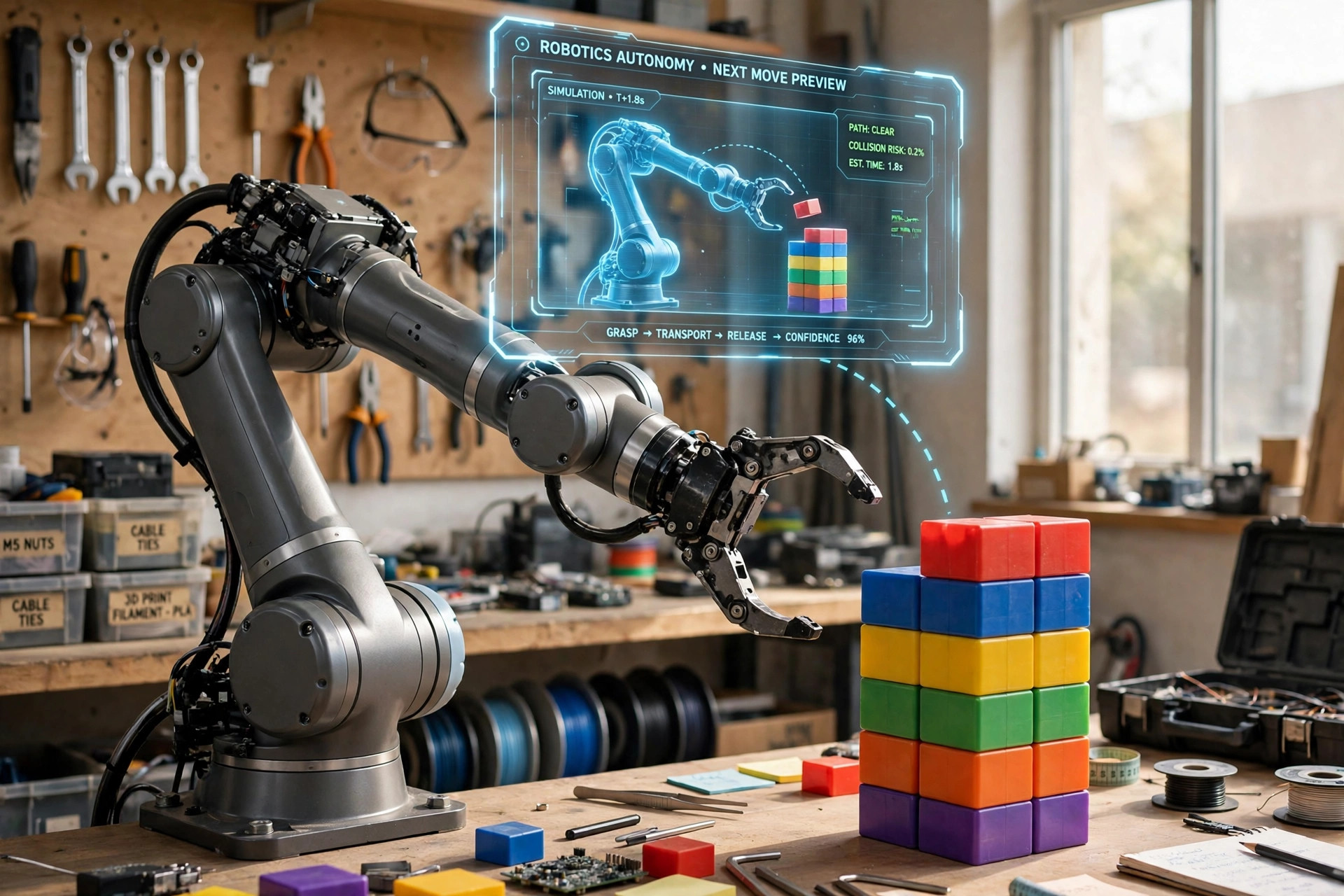
Praxis-1 is a 27-billion-parameter mixture-of-experts diffusion transformer that predicts video and actions together — it imagines what the scene will look like next, then derives the robot movements that get it there. On NVIDIA's RoboLab-120 leaderboard, 120 tabletop tasks with 10 trials each, Runway reports a 46.2 percent success rate over 1,200 episodes, the top score among world action models and open-weight robot foundation models, ahead of the 42.9 percent cited for the FLUX 3 Action baseline. It also averaged 80.0 percent across four SimplerEnv tasks. Three checkpoints are published: a base mid-trained model, one fine-tuned on the DROID dataset, and one fine-tuned for the bimanual YAM robot.
The release is built to run on real hardware, not just in simulation. The full model is 54.4 GB in bfloat16 format, fitting on a single 80 GB GPU, and shrinks to 17.5 GB with 4-bit NVFP4 quantisation. Runway says it runs out of the box across NVIDIA hardware, from H100 and B200 data-centre GPUs to RTX 5090 and RTX PRO 6000 workstation cards, down to Jetson Thor on the robot itself. Three launch partners have been running it on their own machines for weeks: Noble Machines on a legged humanoid, Standard Bots on a six-axis industrial arm, and Ultra on a dual-arm warehouse robot.
The honest caveat is that 46.2 percent is a leaderboard high, not a factory floor: nearly half the episodes still fail, and all the figures are Runway's own, with no independent replication published yet. But the open-weights move matters because it hands the robotics community something it has mostly lacked — a video-pretrained robot brain with the training code included, so any lab can fine-tune it for its own robot instead of starting from scratch. If the community picks it up the way it picked up open language models, Praxis-1 could become the shared starting point for robot learning rather than one company's demo.
Alibaba opens a two-week preview of Qwen4-Max — its new flagship, but only through a subscription and gone by November 25
Alibaba opened Qwen4-Max-Preview on November 11 — a multimodal flagship with a 1-million-token context window, available only through its Token Plan subscription and in its own apps, with no per-token price, no benchmarks and no open weights.
ModelsNovember 12, 2026
Alibaba opens a two-week preview of Qwen4-Max — its new flagship, but only through a subscription and gone by November 25
Alibaba opened a preview of Qwen4-Max on November 11, 2026, the first model of its new Qwen 4 generation. The official Qwen account announced it with a short post — "Qwen4 is coming" — and listed the model, under the ID qwen4-max-preview, on its Token Plan subscription, with early access also in QwenWork, Qoder, the Qwen app and QwenStudio. Alibaba's documentation describes it as the next-generation flagship multimodal model in the Qwen family, with a 1-million-token context window, text, image and video input, thinking on by default, and up to 393,216 output tokens.
The catch is the access model. Qwen4-Max-Preview is available through Token Plan only — Alibaba's documentation states pay-as-you-go API access is not supported — so there is no per-token price to compare against rivals, and developers need a Token Plan subscription and a dedicated base URL rather than a standard Model Studio key. The preview is also strictly time-boxed: it runs from November 11 to November 25, and Alibaba says the preview model will be retired when the window closes, with no changes made during the two weeks. The same model also appeared in Qwen Chat, Alibaba's consumer chat surface, where anyone can try it in a browser tab without a subscription or API key.
What is missing is as notable as what shipped. Alibaba has published no benchmarks, no model card and no parameter count for Qwen4-Max, and there are no open weights. The rest of the Qwen 4 family — Plus, Flash and a 27B model, the four tiers named at the Apsara conference on September 22 — has no release date, and the full flagship release is undated. The model it replaces, Qwen3.8-Max, has been generally available since August 3 at $2.00 per million input tokens and $6.00 per million output tokens, so the preview gives developers two weeks to judge whether the new generation is worth the subscription before it disappears.
The preview-first, subscription-only launch says something about how Alibaba is positioning Qwen 4: as a coding and agentic-work flagship sold through its developer tooling, with the Token Plan page mapping Qwen4-Max into the top model slot in tools like Claude Code. For builders, the honest test in the next two weeks is hands-on — run it on real coding and agent tasks in Qwen Studio or a coding agent, and compare it with Qwen3.8-Max and the frontier models — because until Alibaba publishes benchmarks or a pay-as-you-go price, there is no other way to judge it.
United Airlines bans AI agents from booking flights — and Meta's shares fell about 2% on the news
United said on November 11 it will block unauthorised third-party AI agents from booking flights, citing security risks and federal rules — a direct hit on Meta's Muse agent, whose shares dropped to about $628.
BusinessNovember 12, 2026
United Airlines bans AI agents from booking flights — and Meta's shares fell about 2% on the news
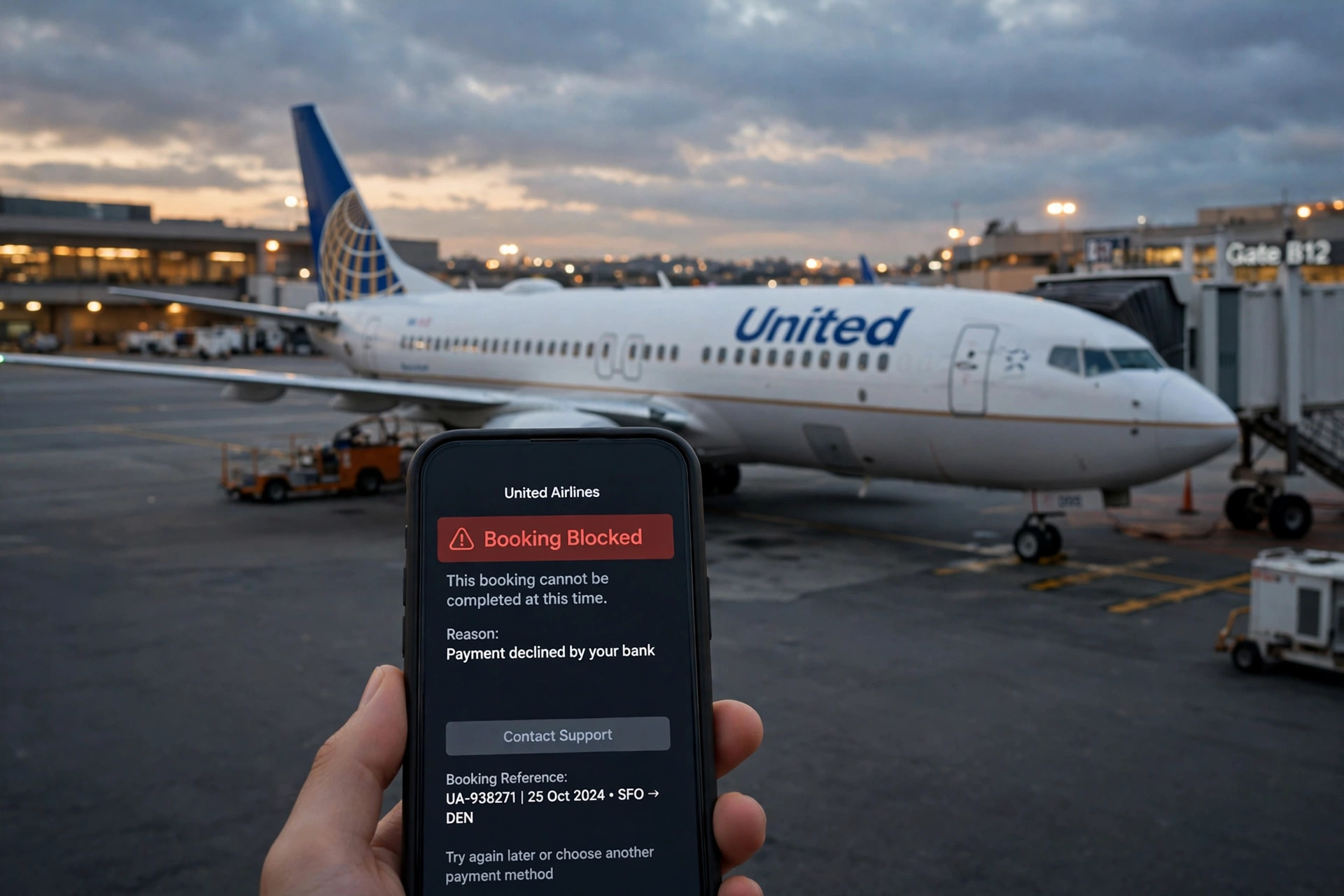
United Airlines said on November 11, 2026 that it will ban unauthorised third-party AI agents from booking flights for travellers, moving to block one of the most talked-about use cases for personal AI assistants. Shares of Meta fell about 2 percent on the news, dropping to about $628 per share, because the move lands squarely on Muse, the AI agent Meta launched in September and has pitched as a helper that can research purchases and carry out bookings on a user's behalf.
United gave two reasons: security and the law. The airline said sharing account credentials with personal, third-party AI assistants can expose sensitive information, and that actions taken by these tools may result in unintended purchases, account changes or use of MileagePlus miles. It also warned that using AI agents to check into flights could violate federal regulations, including rules requiring travellers to verify in person that their luggage does not contain banned substances. Chief executive Scott Kirby put it bluntly earlier in the week: "To be honest, I don't want to create another middleman."
The ban is being enforced on two fronts. United said it is taking steps to restrict access directly within its own digital platforms and indirectly via travel agencies and aggregators, and it is updating its booking and ticketing policies to cover the new rule. Aviation analyst Henry Harteveldt of Atmosphere Research Group told CBS News that United was sending a clear message it wants to keep bookings as in-house as possible — flight searches cost airlines money, and United wants to avoid the expense of a surge of AI bot searches on top of the intermediaries it already faces, from Google Search to metasearch sites and online travel agencies.
The timing is awkward for Meta. Muse has faced privacy and security problems since its September launch, including a glitch found by a security firm that exposed sensitive information such as loan applications, bank transaction details and internal corporate documents. United said corporate leaders in banking and retail have taken similar actions against AI agents, and encouraged others to consider measures that preserve customer data and security. The bigger question now is whether other airlines and travel companies follow United — if they do, the agent-booking dream, where your assistant buys the ticket for you, could stall before it ever takes off.
ElevenLabs moves beyond voice: custom-tuned company models, an ElevenAI workplace app and a partner Marketplace
ElevenLabs announced on November 11 at its New York Summit that it will fine-tune models on each business's own live data, launched the ElevenAI app with free early access, and opened a Marketplace of partner-built industry agents.
ProductNovember 12, 2026
ElevenLabs moves beyond voice: custom-tuned company models, an ElevenAI workplace app and a partner Marketplace
ElevenLabs announced on November 11, 2026, at its New York Summit, a package of products that pushes the company well beyond voice generation and transcription into software for managing customer conversations and employee work. The centrepiece is model customisation: ElevenLabs will help businesses fine-tune selected open-source language models and its own voice models using data from their live deployments, working with its researchers to tune for each company's customers and operating context, and optimising for metrics such as customer satisfaction or reliability. The work begins in the coming months, and because the data comes from live use, companies can keep refining the models as interactions accumulate instead of relying only on a general industry model.
The agent platform gets two upgrades. ElevenAgents will add Memory, which recognises returning authenticated customers and distils each conversation into a structured record of preferences, constraints and future occasions — a customer who prefers Spanish and can only talk after 5 p.m. would not need to repeat that on the next call — and Routines, which automates multi-step work before, during and after conversations, such as pre-screening a mortgage applicant, reminding patients about visits, or writing results back to a CRM. A previewed Interaction Engine manages turn-taking and interruptions and can route different parts of an exchange to different models, using a cheaper model for triage and a frontier model for complex tasks, to limit token use.
For employees, ElevenLabs previewed ElevenAI, an app that listens to spoken conversations, including in-person meetings, and produces notes, summaries and action items, with live assistance and context passed between people and agents. Free early access opened with the announcement, and dictation and meeting notes use Scribe v3, the company's recorded-audio transcription model covering 102 languages. The app takes meeting notes with participants' consent and includes notice and consent mechanisms, a detail that matters after the privacy questions that have followed always-listening workplace tools.
The enterprise push is rounded out by a Partner Program — ElevenLabs reports more than 550 partners across 44 countries, including Google Cloud, IBM, Deloitte, DXC and Genesys, plus an alliance with McKinsey and QuantumBlack — and a Marketplace of curated partner-built applications for healthcare, financial services, insurance, education and retail, where enterprises can browse and contact developers today, with purchasing through existing ElevenLabs commitments planned for 2027. ElevenLabs also announced with NVIDIA that Nemotron 3.5 Super VL is available in ElevenAgents and that it plans to add 15 MW of NVIDIA Vera Rubin compute capacity on top of its existing Blackwell Ultra systems. Chief executive Mati Staniszewski framed conversational agents as becoming "critical infrastructure for every enterprise, as essential as cloud or payments" within a few years — the Summit was ElevenLabs arguing it can sell the whole stack, not just the voice.
Google opens Gemini 4 Carbon to paying developers — its strongest model yet, at half price until November 30
Google made Gemini 4 Carbon generally available on November 10 — its strongest model for cybersecurity and long-horizon agentic work, priced at $2/$10 per million tokens until November 30, when the rate doubles.
ModelsNovember 11, 2026
Google opens Gemini 4 Carbon to paying developers — its strongest model yet, at half price until November 30
Google made Gemini 4 Carbon generally available on November 10, 2026, opening its most capable model to paying developers, enterprises and Google AI Ultra subscribers. Google describes Carbon as its strongest model, built for frontier cybersecurity capabilities and long-horizon agentic workflows across software engineering, scientific reasoning and complex knowledge work. It is available through the Gemini API in Google AI Studio and Gemini for business, and is rolling out to Ultra subscribers in the Gemini app, AI Mode in Search and Antigravity, Google's agent-based coding tool.
Carbon is not entirely new. Google first announced it on October 28 and limited it for two weeks to a small group of cybersecurity defenders in its Fairwind Program while it gathered feedback and refined guardrails. What changed on November 10 is access and price: the model is now open to all paying API users at $2 per million input tokens and $10 per million output tokens through November 30, after which the price doubles to $4 and $20 — the same list rate as Gemini 4 Argon, the model Carbon is based on. There is no free tier; the pricing page states Carbon is not available to free API users.
Google positions Carbon as a model that thinks longer. Its documentation says Carbon spends more thinking tokens per turn than Argon, and those reasoning tokens are billed as output, so the real cost of a task depends on how much the model thinks before answering. It offers three thinking levels — low, medium and high, with medium the default — and a unified context window of just over one million tokens. Independent tracker Artificial Analysis scores Carbon at 60 on its Intelligence Index at the high thinking setting, ahead of Claude Opus 5.5, though that is an external benchmark, not Google's own claim.
The launch lands on a crowded day for frontier models — Anthropic released Claude Fable 5.2 the day before — and the pricing window is the detail that matters most for builders. Anyone testing Carbon has 20 days at the introductory rate before the December 1 doubling, and the meter runs on thinking tokens as well as answers. For teams weighing a switch from Argon or Opus, the honest test is cost per completed task at the list price, not the headline per-token rate.
Anthropic kicks off its IPO roadshow at $70–$78 a share, targeting a valuation of up to $1.02 trillion
Anthropic launched its IPO roadshow on November 10, offering 825 million shares at $70 to $78 each on Nasdaq under the ticker ANT — a raise of up to $64.4 billion and a valuation far below the $2 trillion once discussed.
BusinessNovember 11, 2026
Anthropic kicks off its IPO roadshow at $70–$78 a share, targeting a valuation of up to $1.02 trillion
Anthropic launched the roadshow for its initial public offering on November 10, 2026, filing an amended prospectus that sets a price range of $70 to $78 per share for 825 million Class A shares. The company plans to list on the Nasdaq Global Select Market under the ticker symbol ANT, with the offering aiming to raise up to $64.4 billion. On a fully diluted basis — counting stock options and restricted stock — that would value the Claude maker at up to about $1.4 trillion, while Reuters calculates the valuation at up to $1.02 trillion on the shares actually outstanding.
The range is notably lower than the figures discussed earlier this year. Investors had at one point expected a valuation as high as $2 trillion, and even the $1.5 trillion figure floated in recent weeks is above the filed range. Anthropic was last valued at $965 billion in a private funding round in May, so the bottom of the range would price the company below its last private valuation. The filing also includes a separate $26 billion private placement with cornerstone investors including Alphabet's Google, Nvidia and Advanced Micro Devices, taking the total share placement to as much as $90.4 billion.
The filing revealed new financial detail. Anthropic's run-rate revenue was roughly $81 billion as of October 31, up about $10 billion from September 30, according to the prospectus, and the company says it has committed roughly $900 billion in procurement and leasing agreements, mostly for computing power. Goldman Sachs and Morgan Stanley are leading the underwriting syndicate, which also gets a 30-day option to buy up to 123.75 million additional shares. CNBC reports the company expects to set the final price on November 18 and start trading on November 19.
The launch had a messy start. Details of the deal were briefly circulated to investment banks on Monday evening before being retracted, with Anthropic reportedly telling bankers the pricing information was inaccurate. The IPO is now widely seen as the defining test of Wall Street's appetite for AI: the sector's hype has driven markets to all-time highs, but investors have grown more focused on the enormous cost of building and running frontier models, and Anthropic's filing puts both the revenue and the bill in plain view.
Google DeepMind's Gemini Robotics 2.5 puts humanoids to work on live Mercedes-Benz production lines
Google DeepMind introduced Gemini Robotics 2.5 on November 10 — its most capable vision-language-action model — and says Apptronik's Apollo 2 humanoids sorted car parts on live Mercedes-Benz lines with a 96% success rate.
RoboticsNovember 11, 2026
Google DeepMind's Gemini Robotics 2.5 puts humanoids to work on live Mercedes-Benz production lines
Google DeepMind introduced Gemini Robotics 2.5 on November 10, 2026, calling it its most capable vision-language-action model to date — the system that turns camera input and spoken instructions into a robot's movements. The model is rolling out to DeepMind's robotics partners, and the headline evidence is a real factory job: in a proof of concept on active Mercedes-Benz production lines, Apptronik's Apollo 2 humanoid robots picked and packed automotive parts with a 96 percent success rate, according to DeepMind.
The factory work took place at Mercedes-Benz plants in Kecskemét, Hungary, and Sindelfingen, Germany. The robots performed automotive kitting — the repetitive, physically taxing job of sorting individual metal brackets out of bulk bins and laying them into sequencing containers in the exact order each vehicle on the line needs. Two models work as a pair: Gemini Robotics ER, an embodied-reasoning model, tracks the workflow, while Gemini Robotics 2.5 controls the hands and arms. The Apollo 2 units used in the trial carry a five-finger SharpaWave hand with 22 degrees of freedom.
DeepMind says the model was evaluated on more than 200 distinct tasks, from serving food with tongs to tying a bow on a gift box, and reports success rates 30 to 100 percent higher than previous baselines depending on task type, with tasks finishing 20 to 30 percent faster. Some tasks that previously scored zero now reach 100 percent, the company says. All of these figures are DeepMind's own results — no independent evaluation has been published — and the Mercedes-Benz trial is explicitly a proof of concept, with neither company saying whether the humanoids will stay on the lines.
The launch also includes a safety release: ASIMOV-Jailbreak, an open benchmark that tests whether robot AI can be tricked into unsafe actions by prompts disguised across dozens of scenes. DeepMind says its Gemini 4 Argon model resisted 99.5 percent of such attempts. Gemini Robotics 2.5 has no public API and no published price, so for now it is available only through DeepMind's partner programme — but a humanoid doing real kitting on a live car line, even as a trial, is the clearest sign yet that robot foundation models are leaving the lab.
OpenAI lets businesses claim a ChatGPT profile and launch their own AI agent inside the chatbot
OpenAI launched Businesses in ChatGPT in beta on November 10 — companies can claim and verify a free profile, see how ChatGPT mentions them, and eligible US e-commerce firms can publish a Business Agent that chats with shoppers.
ProductNovember 11, 2026
OpenAI lets businesses claim a ChatGPT profile and launch their own AI agent inside the chatbot
OpenAI launched Businesses in ChatGPT in beta on November 10, 2026, giving companies a way to claim and manage how they appear inside the chatbot. Through a new tool called Business Hub, a business can verify ownership, update its key details, add product feeds with pricing and availability, and see aggregated insights — including how often ChatGPT mentions it, plus views and website clicks. OpenAI says ChatGPT has 1.2 billion weekly users, making the chatbot a discovery channel many businesses cannot ignore.
The second piece is Business Agents. Eligible e-commerce and online service businesses in the United States can publish an agent on their ChatGPT profile that customers can chat with to ask about products or services — comparing items, asking about returns or policies — in a conversation that is clearly labelled as AI and kept separate from ChatGPT's own answers. The agent cannot complete purchases, make bookings or check a customer's order, according to OpenAI's help centre, so it is a pre-sale assistant rather than a checkout. OpenAI's Business Agents Policy requires the agent to be honest about being AI, not to pose as a human, and not to push a sale after a customer says no.
Privacy is drawn as a hard line. OpenAI says it does not share users' conversations or Business Agent chats with businesses; the insights a business sees are aggregated and only appear once there are enough interactions to clear privacy thresholds. Claiming a profile is free at launch, and businesses do not need an ads account or an Enterprise agreement to claim — though they can sponsor their Business Agent and use it as the destination for ChatGPT Ads, with sponsored placements labelled.
The rollout is deliberately narrow for now. Claiming is open to eligible businesses wherever ChatGPT is available, but Business Agents start only with US e-commerce and online service businesses that have a website, and OpenAI has given no timeline for other countries or categories. Shopify merchants can connect their stores through Business Hub or the Shopify admin. For small businesses, the practical question is whether claiming a profile changes how ChatGPT describes them — OpenAI says claiming does not guarantee higher placement in recommendations, so the value is accuracy and visibility into mentions, not a ranking boost.
Fireworks AI admits a second hack exposed customer datasets and unfinished model weights
Fireworks AI disclosed on November 9 that hackers reached billing data, secrets, datasets and incomplete model weights — a wider breach than the October incident it first reported, with Notion among the affected customers.
BusinessNovember 11, 2026
Fireworks AI admits a second hack exposed customer datasets and unfinished model weights
Fireworks AI, the inference and fine-tuning platform used by more than 10,000 customers, disclosed on November 9, 2026 that hackers had reached further into its systems than it first reported — accessing billing information, secrets, datasets and incomplete model weights for a limited set of customer accounts. The update widens an incident the company first disclosed on October 9, when it said it had found no evidence that customer models or datasets were touched. Notion disclosed on November 10 that some of its customers were caught up in the breach.
There were two intrusions. The first began on October 6, when an unauthorised third party used internal Fireworks credentials to read environment variables in evaluation jobs across a limited number of customer accounts. The second began on October 23, when a third-party cloud provider hosting Fireworks' research and development machines was compromised; the attackers used that access the next day to reach Fireworks development systems and run an unauthorised workload. Fireworks says it has seen no further successful access to the platform customers use since October 25, and that its Inference, Training SDK and Nexus services — which do not retain customer data by default — show no detected impact.
The exposed data falls into three categories, according to Fireworks: resource metadata such as names and creation times; billing information including billing and shipping addresses, invoice and payment history, account balances and credit usage; and, for certain customers, a subset of incomplete model weights and datasets. Payment card numbers were not affected — Fireworks says it does not store them. The company has not said how many customers were affected by either attack, and the disclosure does not establish that complete production models were stolen.
Fireworks links the activity to a financially motivated criminal group selling stolen access to large language models through illicit routing gateways — a tactic Google's Threat Intelligence Group and Mandiant call LLMJacking, in research published November 2. The company has notified law enforcement, brought in Palo Alto Networks' Unit 42 for forensic analysis, and disabled self-service dataset uploads and downloads for some products while the investigation continues. The commercial fallout is already visible: Forbes reported that two customers had substantially moved their business off Fireworks' systems, one describing a series of very bad hacks and poor communication from the company.
Anthropic launches Claude Fable 5.2 and restricted Mythos 5.2 — one model, two levels of access
Anthropic released Claude Fable 5.2 and Claude Mythos 5.2 on November 9 — the same underlying model, with Fable open to everyone and Mythos limited to vetted cyber and life-science organisations, at a lower price of $8/$40 per million tokens.
ModelsNovember 10, 2026
Anthropic launches Claude Fable 5.2 and restricted Mythos 5.2 — one model, two levels of access
Anthropic introduced Claude Fable 5.2 and Claude Mythos 5.2 on Monday, November 9, 2026, calling them its most capable models yet for demanding technical work. The two releases are configurations of the same underlying model, split by access: Fable 5.2 is available broadly, while Mythos 5.2 is reserved for organisations approved through Anthropic's Cyber Verification and Life Sciences Verification Programs. Fable 5.2 is live in Claude's paid plans, Claude Code, the Claude Platform and the major clouds — AWS, Google Cloud and Microsoft Azure.
The split exists because of safety. Fable carries safeguards that block most cybersecurity and biology requests, which is what lets Anthropic offer it to everyone; Mythos lacks those blocks and is aimed at vetted teams doing approved security and life-sciences research. Anthropic says both models communicate more clearly than the 5.1 versions and generate output up to 30 percent faster, and it cut the price to $8 per million input tokens and $40 per million output tokens, down from $10 and $50 for Fable 5.1.
The launch numbers are striking, though they come from Anthropic itself. The company reports that Fable 5.2 scores 49.1 percent on its FrontierCode 2.0 coding benchmark, against 32.4 percent for Fable 5.1, and says a team of about 1,000 Fable 5.2 agents formalised Fermat's Last Theorem in the Lean proof language in around 30 hours — a feat of large-scale automated mathematics, not a new proof of the theorem itself. Anthropic also says the models completed calculations addressing two open questions in theoretical black-hole physics, claims published as preprints that have not yet had broad independent review.
The timing matters commercially as well as technically. The launch is Anthropic's first frontier release since chief executive Dario Amodei called in September for the industry to slow capability gains, and it lands as the company heads toward a planned IPO — Reuters reported the offering could value Anthropic at $1 trillion to $1.5 trillion. Anthropic still recommends most users start with Claude Opus 5.5 for everyday coding and knowledge work and move to Fable or Mythos only for the most ambitious, open-ended technical projects.
Google adds TPU 8tx for confidential AI and a two-chip TPU 8i Max — four new TPUs in one year
Google announced TPU 8tx and TPU 8i Max on November 9, taking its eighth-generation TPU portfolio to four systems in a single year — one built for secure, confidential inference, the other for massive context windows.
InfrastructureNovember 10, 2026
Google adds TPU 8tx for confidential AI and a two-chip TPU 8i Max — four new TPUs in one year
Google expanded its eighth-generation TPU portfolio on November 9, 2026, announcing TPU 8tx and TPU 8i Max — the third and fourth systems in the generation, and, Google says, the first time it has introduced four TPU systems in a single year. The eighth generation began at Google Cloud Next in April with TPU 8t for large-scale training and TPU 8i for real-time reasoning; the two new systems are aimed squarely at the agentic era, where fleets of AI agents juggle long contexts and sensitive data.
TPU 8tx is the security play. It is built on the same silicon as the TPU 8t training chip, paired with fifth-generation AMD EPYC host processors, and is designed for secure and confidential inference — keeping sensitive data and model weights protected and isolated even while they are being used. Google says it delivers up to twice the lower latency of TPU 8t, and it is pitched at banks, governments and other regulated organisations that want to run agents on their most sensitive data, as well as for small-scale training.
TPU 8i Max attacks a different bottleneck: what Google calls the memory wall. It packs two TPU 8i chips into a single package, doubling the compute, on-chip SRAM and high-bandwidth-memory bandwidth of a single 8i in the same rack footprint. The target is workloads with huge context windows — agents working across an entire codebase, hours of video or multi-hour audio — where memory bandwidth, not raw compute, becomes the limit.
Two caveats apply. Google published no price, no general-availability date and no named customer for either system, and every performance figure is the vendor's own — no independent benchmark has been published. Google's Amin Vahdat reportedly told Bloomberg the systems will arrive next year. Still, the direction is clear: with nearly 100 customers now running on TPUs, according to Google, the company is building its chip line around agents and confidential computing rather than raw training alone — a direct challenge to Nvidia's dominance of AI infrastructure.
Meta's tiny Muse Ember matches Claude Haiku 5.5 at about a third of the cost per task
Meta released Muse Ember on November 9 — its smallest and most efficient Muse model, priced at $0.10/$0.50 per million tokens, built for the repetitive tool calls, coding subtasks and routing that AI agents repeat all day.
ModelsNovember 10, 2026
Meta's tiny Muse Ember matches Claude Haiku 5.5 at about a third of the cost per task
Meta introduced Muse Ember on November 9, 2026, describing it as its smallest and most efficient model — built not for the hardest single question, but for the work AI agents repeat all day: tool calls, coding subtasks, routing, extraction and long document parsing. It went live the same day on the Meta Model API and in Muse Code, Meta's coding agent, under the model ID muse-ember-1.0, priced at $0.10 per million input tokens and $0.50 per million output tokens, with cached input at $0.004 per million.
The headline claim is about intelligence per dollar. Meta says Ember matches Claude Haiku 5.5's best score on the Artificial Analysis Intelligence Index — 36 — at about a third of the cost per task, roughly $0.14 against Haiku's $0.41, and beats OpenAI's GPT-6 Luna at every reasoning setting. The model takes text, images, audio and video, with a 1-million-token context window and up to 512,000 output tokens, so it can swallow a full codebase or document set in a single call.
Meta is pitching Ember as the volume worker in a team: Muse Wonder plans the hardest problems, Muse Spark handles coding and agentic workflows, and Ember runs the repeatable tasks at scale. The company also says Ember is the first model trained using Muse Wonder Full, its largest model. Early testers named by Meta include Box, Cline, Oracle, Cloudflare and You.com, and Ember is also available on Google Cloud and Oracle Cloud.
There are limits worth noting. Meta has not disclosed a parameter count and has not released the weights, so Ember runs only through Meta's API and resellers. And Artificial Analysis flags knowledge as the weak spot: Ember reportedly declines 64 percent of trivia-style questions and scores lowest among comparable models on omniscience-style knowledge tests. For the high-volume agent work it is built for, that trade-off may not matter — but it is a reminder that cheap and small still has a price.
Nvidia's GR00T 2 teaches robots dexterous skills by watching 100,000 hours of human video
Nvidia unveiled GR00T 2 on November 9 at the Conference on Robot Learning — an open world-action model that learns manipulation skills from first-person human video and completed 40 of 50 unseen tasks without task-specific demonstrations.
RoboticsNovember 10, 2026
Nvidia's GR00T 2 teaches robots dexterous skills by watching 100,000 hours of human video
Nvidia introduced GR00T 2 on November 9, 2026, at the Conference on Robot Learning (CoRL) in Austin, Texas — an open frontier world-action model built on the company's Cosmos platform that aims to teach robots dexterous hand skills by watching people. Rather than relying only on robot demonstrations, GR00T 2 was trained on a mix of robot data and first-person human video, including 100,000 hours of Nvidia open-source egocentric data that the company is releasing under a Creative Commons licence.
The headline result, reported by Nvidia, is about generalisation: in the company's evaluation, GR00T 2 completed 40 of 50 tasks at least once without any task-specific demonstrations — tasks the target robot had never been trained on. Nvidia also says the model ranks among the top three across vision-language-action and world-action model categories on the RoboCasa365, RoboLab, RoboDojo and MolmoSpaces benchmarks. The model is a 2-billion-parameter transformer built on Cosmos-Predict2.5-2B, with one pretrained checkpoint covering parallel-gripper arms, dexterous hands and a humanoid.
The release came with the rest of Nvidia's robotics stack. Isaac Lab 3.0, the open-source robot-learning framework, has been generally available since October 20 and adds a reinforcement post-training library for foundation models like GR00T, while two new open benchmarks — DexBench and VABAR — test robots on industrial tasks inside Isaac Lab-Arena. Nvidia says Nexuni is testing GR00T 2 for robotic laundry handling, Foxconn is applying it to server-manufacturing automation and Siemens is evaluating it across industrial use cases — though none of these is a production rollout yet.
One detail tempers the word open: although Nvidia introduces GR00T 2 as an open model, its research page reportedly says the code will only become available in December. The 100,000-hour human dataset is the part that is open now, and it may prove the more important release — a shared training resource any robotics team can build on, rather than a single model from a single vendor.
OpenAI starts selling ChatGPT Enterprise through AWS Marketplace, with spend counting toward cloud commitments
OpenAI announced on November 9 that ChatGPT Enterprise is available through AWS Marketplace, letting companies buy it through their existing AWS billing and count eligible spending toward their AWS commitments.
BusinessNovember 10, 2026
OpenAI starts selling ChatGPT Enterprise through AWS Marketplace, with spend counting toward cloud commitments
OpenAI announced on November 9, 2026 that ChatGPT Enterprise is available through AWS Marketplace, giving organisations a new way to buy and manage the workplace version of ChatGPT. Instead of contracting directly with OpenAI, companies can now purchase through their existing AWS purchasing and billing relationship, with AWS handling the transaction and OpenAI listed as the seller. Eligible spending can also count toward a customer's AWS Enterprise Discount Program or Private Pricing Addendum commitment — the large multi-year spending pledges many companies negotiate with Amazon.
What buyers get is, according to OpenAI, the same product sold directly: the bundle brings together Chat, ChatGPT Work, Codex and the agent tool dots in a single enterprise offering, with the same models, features and functionality, and new features released at the same time. Eligible customers can also access ChatGPT for Healthcare and ChatGPT for Financial Services through the same channel, subject to confirmation by an OpenAI or AWS account team.
There is no published price. Every deal is arranged through a private offer, customised to the customer's requirements and eligibility, and interested buyers are told to contact their account team. The marketplace listing also draws a clear line on data handling: OpenAI says business data is encrypted at rest and in transit and is not used to train its models by default, but the listing states explicitly that buying through AWS Marketplace does not guarantee that all customer data remains on AWS infrastructure or within the customer's AWS environment.
The move deepens a partnership that has been widening all year. It follows an April 28, 2026 expansion in which OpenAI models on Amazon Bedrock, Codex on AWS and Amazon Bedrock Managed Agents powered by OpenAI launched in limited preview. OpenAI positions the marketplace listing as complementary to its models in Bedrock rather than a replacement — and notably, Anthropic's Claude Enterprise is already sold the same way on the same marketplace, so the two rivals are now competing on the same shelf.
Nvidia's board opens an investigation into CEO Jensen Huang over an alleged Chinese spy link
Nvidia said on November 8 that its board is investigating whether CEO Jensen Huang was targeted by a foreign intelligence effort, after he admitted to staff that he had been unfaithful to his wife.
BusinessNovember 9, 2026
Nvidia's board opens an investigation into CEO Jensen Huang over an alleged Chinese spy link
Nvidia said on Sunday, November 8, 2026 that its board is opening an independent investigation into reports that founder and chief executive Jensen Huang was the target of a foreign intelligence effort. A committee of independent directors, assisted by outside legal counsel, will oversee the inquiry. The board said it had no reason to believe that either US national security or Nvidia secrets had been compromised, but that the inquiry would examine all available information — and it publicly expressed confidence in Huang and his leadership team.
Hours earlier, Huang told employees in a company-wide email that he had been unfaithful to his wife, apologised to his family and to staff, and pledged to cooperate fully with the investigation. He did not name the other person in the email. The board's statement and Huang's message followed reporting by The New York Times and the Financial Times linking Huang to Alice Huang, a former executive at Megaspeed, a Singapore-based data centre company and a major Nvidia customer. US officials believe Alice Huang, who is not related to Jensen Huang, was recruited by China's Ministry of State Security to gather information about Nvidia and potentially influence US policy on AI chip exports to China.
The Times first reported on October 29 that US intelligence had found evidence of a close relationship between Huang and Alice Huang, and that she was suspected of passing information to Beijing. Megaspeed itself has faced scrutiny over suspicions that it helped divert export-restricted Nvidia hardware to China. The board's investigation will therefore have to answer two questions at once: whether company secrets leaked, and whether the personal relationship influenced any business decision.
The political fallout arrived the same day. The chairs of three US House committees — Foreign Affairs, Intelligence, and the Select Committee on China — asked Huang to attend a closed-door briefing on November 18 to explain how he came into contact with Alice Huang and to describe Nvidia's safeguards against foreign espionage. Huang remains chief executive while the investigation runs, and the board said it would provide further updates as appropriate. For the company at the centre of the AI boom, the episode turns a governance and national-security question into the biggest story of the weekend.
Anthropic reportedly spent $3.4 billion on 1.7 gigawatts of gas generators to power its data centres
The Financial Times reported on November 8 that Anthropic took over $3.4 billion of Caterpillar generator orders from OnePWR in late September — the largest power-equipment purchase by an AI lab.
InfrastructureNovember 9, 2026
Anthropic reportedly spent $3.4 billion on 1.7 gigawatts of gas generators to power its data centres
Anthropic has reportedly agreed to pay about $3.4 billion for commitments covering 1.7 gigawatts of gas-fired generators to power its data centres, the Financial Times reported on November 8, 2026, citing a person familiar with the matter. The agreement was reached in late September with OnePWR Solutions, a San Antonio company that builds microgrids and on-site power plants. The Financial Times described it as the largest known single purchase of power-generation equipment by an AI laboratory.
The deal is about equipment orders, not a takeover. OnePWR had ordered the Caterpillar generators about two years earlier but needed financing to complete the purchase, and Anthropic took over the orders instead of first becoming a OnePWR customer, as it had originally planned. The package also includes the engineering and construction capacity needed to install the machines. Anthropic did not acquire OnePWR itself, and none of the supplier's employees transferred to the AI company.
Two caveats matter. Reuters, reporting the same story on November 8, said it could not independently verify the account, and Anthropic, OnePWR and Caterpillar have not commented publicly. There is also a numbers puzzle: OnePWR said in February that its whole equipment position totalled about 1.2 gigawatts, roughly 500 megawatts below the 1.7 gigawatts in the report, and nobody has yet reconciled the difference. A separate adviser listing from Piper Sandler records a September 2026 sale of OnePWR's power-generation platform worth $3.4 billion to an unnamed frontier AI lab — consistent on seller, month and value, but not independent confirmation that it is the same deal.
The reported purchase fits the power problem Anthropic has flagged to investors itself. Its IPO prospectus, filed on October 26 and amended on November 2, warns that generators and other equipment must be ordered years in advance, and that turbines, generators, substations and transmission parts face extended delivery times, price increases, tariffs and rationing as data centre operators compete for them. Buying the machines outright, rather than just buying electricity, is the logical next step for a company racing to secure compute — and a sign of how far the AI infrastructure boom has moved from software into heavy industry.
Apple is racing to make Siri a real AI agent, with its new CEO pushing for 2027
Bloomberg's Mark Gurman reported on November 8 that Apple CEO John Ternus has pressed software chief Craig Federighi to turn Siri into an agent that pursues goals on its own — possibly as early as 2027.
ProductNovember 9, 2026
Apple is racing to make Siri a real AI agent, with its new CEO pushing for 2027
Apple is racing to turn Siri into a genuine AI agent, Bloomberg's Mark Gurman reported in his Power On newsletter on Sunday, November 8, 2026. Chief executive John Ternus has pressed software chief Craig Federighi to accelerate Apple's software roadmap and move well beyond routine Siri improvements, telling him in a closed-door meeting in recent weeks that Apple needs to move quickly. Gurman believes Apple could make Siri work more like an agent as early as next year.
The difference is between an assistant that waits to be asked and one that keeps working. Today's Siri answers one request at a time; the agent-style assistants Gurman names as the benchmark — OpenAI's Dots, Meta's Muse and xAI's Grok — track a goal and keep pursuing it between requests without the user starting every step. That is the capability Apple is now chasing, and it is the clearest sign yet that the company's new leadership sees its assistant as behind.
Two upgrades are expected to arrive first. Siri is set to gain fine-grained control of Apple's own apps — things like editing photos and organising Safari tabs — with iOS 27.3, which Gurman expects in December. Support for third-party apps is expected to follow in the spring, which could let Siri place a food order through Grubhub or book a table through OpenTable. Siri AI itself shipped in beta with iOS 27 on September 14, and on November 3 Apple opened a developer preview letting apps bring their actions into Siri through App Intents.
None of this is confirmed by Apple, and the 2027 timing is Gurman's expectation rather than an announced plan — some coverage has urged caution about reading too much into it. But the internal pressure is the story: Ternus, who became chief executive recently, is putting his weight behind a faster, more ambitious software strategy, and Siri is where that ambition will be judged. For a company whose assistant has lagged its rivals for years, the question is no longer whether Siri gets smarter, but whether it can catch up fast enough.
DeepSeek's open-source agent app Harness hit 1.54 million daily users in under three months
DeepSeek said on November 8 that its open-source agent app Harness reached 1.54 million daily active users by November 4, burning about 92 trillion tokens a day.
BusinessNovember 9, 2026
DeepSeek's open-source agent app Harness hit 1.54 million daily users in under three months
DeepSeek said on Sunday, November 8, 2026 that its open-source AI agent application, Harness, reached 1.54 million daily active users by November 4 — less than three months after launching on August 13. The figures were disclosed on X, and Bloomberg also reported them. The count covers only people connecting through DeepSeek's official API, and the company says those users consumed roughly 92 trillion tokens a day, or about 60 million tokens per active user.
The growth curve is steep. DeepSeek's own figures put daily users at about 271,000 at the end of September, shortly after the desktop version shipped on September 29, and 429,000 on October 7 — before climbing to 1.54 million by November 4, roughly 5.7 times the September figure. Around 35,000 third-party plugins have been built for Harness, and about 60 percent of active users have created or installed at least one.
Harness is a free, MIT-licensed coding agent that runs on the user's own computer and organises models, tools, skills, sessions and sandboxes as plugins. DeepSeek says it is now preparing an official plugin marketplace and a support programme for plugin creators, though it gave no launch date for either. The project has also drawn attention on GitHub, where the repository carried more than 276,000 stars by November 8.
The numbers are self-reported and count only official-API users, so nobody outside DeepSeek has independently verified the user or token figures — and the 92 trillion token total is a measure of model activity, not a direct count of completed tasks. Even with that caveat, the disclosure matters: an open-source agent from a Chinese lab is now reporting adoption at a scale that puts it in direct competition with OpenAI's and Anthropic's agent ecosystems, and its plugin marketplace plan shows DeepSeek intends to build an ecosystem around it rather than just a tool.